
You look at a sentence and understand it immediately. You hear it in a lesson and think, “Yes, I know that.” Then someone asks you to say it without looking—and suddenly half of it disappears.
This is one of the most normal beginner experiences in language learning.
It does not mean that you learned nothing. It usually means that the sentence is familiar, but it is not fully available yet. Recognition has started, while recall still needs practice.
That difference matters because real conversations do not give you a multiple-choice list. You have to bring the words back yourself, in the right order, while also thinking about pronunciation, meaning, and what the other person might say next.
Recognition feels easier than recall
Imagine you are learning the sentence, “I usually take the bus to work.”
When you read it, every word may seem easy. You know usually. You know bus. You know work. But when you close the lesson and try to say the full sentence, you might produce:
I usually… go work… by bus?
That attempt is not a failure. It shows exactly what still needs strengthening.
Listening, reading, and watching videos are useful because they help you become familiar with a language. But familiarity can create a small illusion: because something looks understandable, we assume we can already use it.
The simplest way to check is to hide the answer and try to speak or write it.
“Almost correct” is useful information
Beginners sometimes feel frustrated when they get nine sentences right and miss the tenth. It feels unfair to focus on one mistake after doing so much correctly.
A better way to see it is this: the mistake has shown you where the weak connection is.
Maybe you forgot a preposition. Maybe you changed the word order. Maybe you remembered the meaning but not the exact sentence pattern. These are small problems, but they often return when you are speaking under pressure.
Correcting them immediately is not punishment. It is focused practice.
This is also why repetition should not mean looking at the same sentence twenty times. Useful repetition asks you to retrieve it again. Each attempt should involve a little work from your memory.
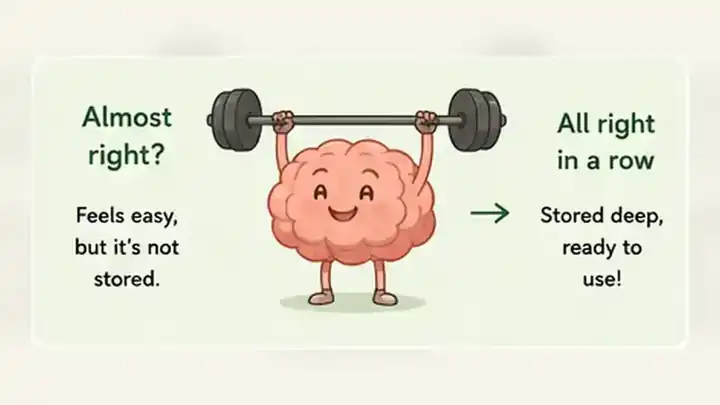
The goal is not to make practice feel difficult for no reason. It is to strengthen the part that is still weak.
Why starting again can help
In KeepSaying’s test mode, getting a sentence wrong sends you back to the first sentence in the set. You continue until you can get the whole set right in a row.
At first, restarting can feel annoying—especially when the mistake happens near the end. But the purpose is not to make the test artificially difficult. The restart creates another chance to recall every sentence, including the ones you thought you already knew.
It changes the goal from “I saw all the answers once” to “I can produce the entire set reliably.”
That is a more useful kind of confidence.
One successful round does not mean a sentence is permanently memorised. You still need to revisit language over time. But completing a set correctly gives you stronger evidence that the language is becoming available, not merely familiar.
Speaking and writing reveal different gaps
Speaking and writing are both forms of output, but they do not feel exactly the same.
Speaking asks you to retrieve language quickly. You have less time to rearrange a sentence, and pronunciation adds another layer of effort.
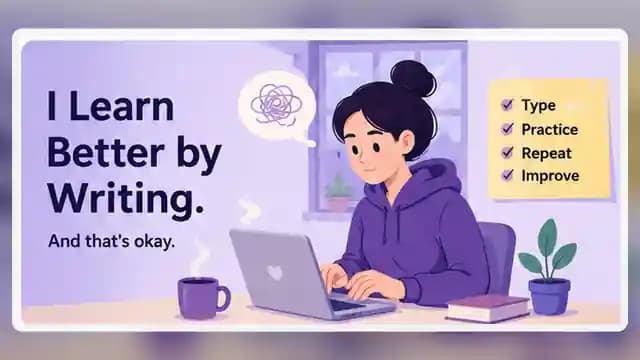
Writing gives you a little more space to think. It can make missing endings, spelling mistakes, and word-order problems easier to notice. For learners who type quickly, writing can also be an efficient way to complete many focused attempts with very little idle time.
You do not have to choose one forever. Writing can help stabilise a sentence, and speaking can help make it usable in conversation.
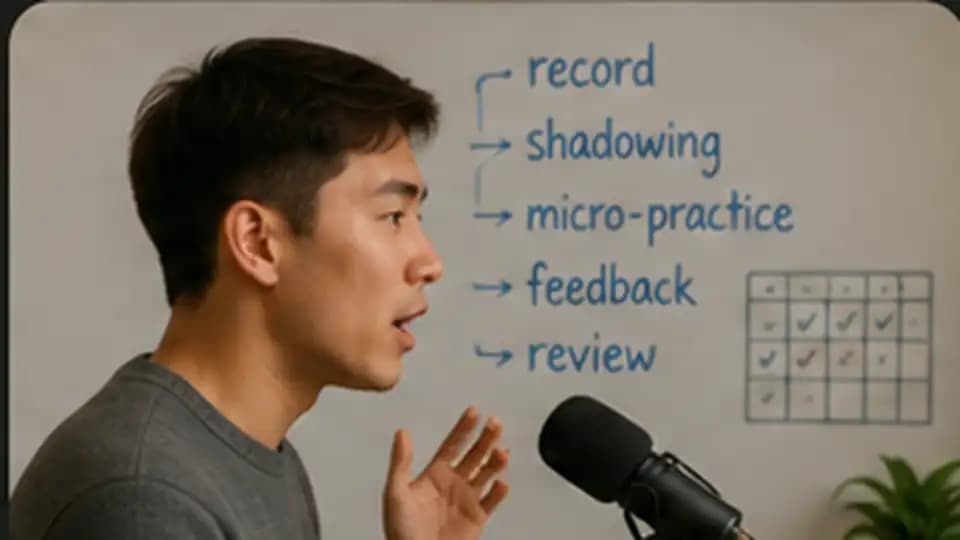
A simple sequence might be:
- Read and understand the sentence.
- Hide it and type it from memory.
- Check the details.
- Say it aloud without looking.
- Return later and test yourself again.
KeepSaying has four practice modes built around this broader idea: beginners need chances to speak, write, repeat, and recall useful sentences—not only consume more content.
A ten-minute practice loop
You do not need a heroic two-hour study session to practise this way.
Choose five useful sentences connected to one situation, such as introducing yourself, ordering food, or explaining your daily routine.
Spend the first two minutes understanding them. Then spend several minutes writing or speaking without looking. Check each answer carefully. When something is wrong, correct it and return to the beginning of the small set.
Use the final minute to say all five sentences once more.
That may sound basic, but basic is not bad. Beginners need language that is simple enough to practise fully. A short sentence you can actually recall is more valuable than an impressive paragraph you can only recognise.
Progress can feel repetitive before it feels fluent
Language learning often feels slow because the most important work is not always exciting. You meet a sentence, forget part of it, correct it, repeat it, and come back tomorrow.
There is no dramatic shortcut hidden inside that process. Consistency is the closest thing we have to one.
The good news is that you do not need perfect motivation. You need a practice method that still works on an ordinary day, when you only have ten minutes and your brain feels slightly tired.
KeepSaying was created from a real study method that felt useful: practise beginner sentences actively, check the result, and keep going until they come back correctly. The app turns that loop into focused speaking, writing, repetition, and test practice.
You will still forget things. Everyone does. The goal is not to avoid forgetting completely. It is to build a routine that gives you enough chances to retrieve the language again.
When “I recognise this” slowly becomes “I can say this,” that is real progress.
The illustrations in this article were generated with AI.
Try a short, focused set today and keep going until the sentences come back without help. You can practise with KeepSaying at https://keepsaying.com