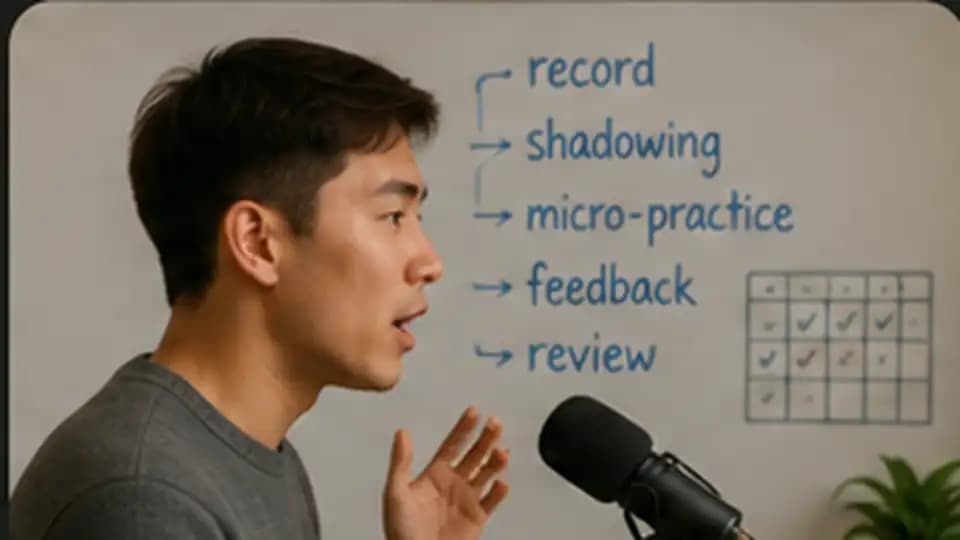
KeepSaying started as a speaking-practice product. The name is not subtle: you keep saying useful vocabs until they start coming out more naturally.
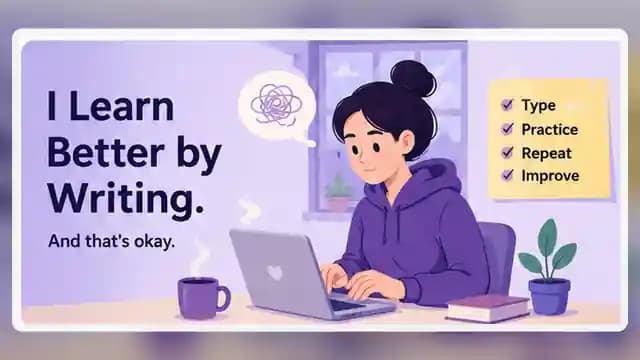
So I did not expect Writing Mode to become one of the parts that worked best for me.
I am stronger at reading and writing than listening and speaking. When I write, I get a few extra seconds to search my memory, test a sentence, and notice what looks wrong. I also type quickly—possibly faster than I speak, which is a mildly ridiculous problem for someone building a speaking app.
Yes, speaking still matters
I understand the usual advice. Listen more. Speak more. Read harder material. Expand your vocabs. Eventually, you should be able to follow real conversations, news, and TV—not only understand “Hello, how are you?”
That is all true. Input and output both matter. Within output, speaking and writing train overlapping but different skills.
But beginners do not live at the destination. They live in the awkward stage where every sentence takes effort, a familiar vocab suddenly disappears, and pressing the microphone can make the whole brain go blank.
At that stage, the best method is not necessarily the one that wins an argument on YouTube. It is the one that helps you practise today and come back tomorrow.
Writing is still real output
There is a big difference between recognising a vocab and producing it.
When I see a vocab in a list, I may think, “Of course I know that.” But when I have to type it without seeing the answer, I have to retrieve the form from memory. That is much closer to the problem I face in conversation: I need to produce something, not simply recognise it.
A study comparing receptive and productive retrieval found that productive retrieval was especially effective for productive vocabulary knowledge (Yanagisawa, 2016). A semester-long study also found that cumulative vocabulary tests produced better receptive and productive learning than non-cumulative tests (Nakata, Tada, McLean, and Kim, 2021).
Feedback matters too. In experiments with beginner French vocabs, retrieval practice without corrective feedback did not outperform restudying, while retrieval practice with feedback did (Yang et al., 2022).
That matches what I feel in KeepSaying. Typing by itself is not magic. The useful loop is:
retrieve → check → correct → retrieve again
Why the repeat-until-correct loop works for me
In the test flow I used, getting an answer wrong sends me back through the set. I have to continue until I finish without mistakes.
That sounds strict, but it gives repetition a clear purpose. I am not typing the same thing because an app wants more screen time. I am repeating because there is still one vocab I cannot reliably produce.
The loop gives me a few things I really like:
- A clear finish line: I know what “done” means.
- Immediate correction: I cannot quietly treat a half-known vocab as learned.
- More useful repetition: Difficult vocabs naturally get more attempts.
- Momentum: Because I type quickly, I can keep moving without waiting, recording, or replaying every attempt.
Output may also help learners notice the gap between what they want to say and what they can actually produce. Research on this “noticing” effect is not perfectly consistent, but work using writing and text-reconstruction tasks found that extended output opportunities combined with relevant input were important for improving use of a target structure (Izumi and Bigelow, 2000).
For me, the noticing is very concrete. I think I know a vocab. I type it. It is wrong. Now I know exactly what I do not know.
Who may fit this method
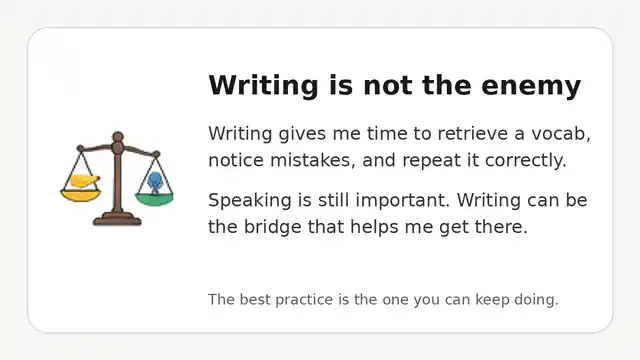
Writing-first practice may work especially well for learners who:
- understand more than they can produce;
- are stronger at reading and writing than listening and speaking;
- freeze when speaking puts them under time pressure;
- type quickly and enjoy short, focused test loops;
- want to strengthen spelling, vocab forms, and sentence structure;
- need a low-pressure way to begin producing the language.
It may also suit beginners who are not ready for open conversation. “Talk about anything for ten minutes” sounds freeing when you are intermediate. At A1, it can feel like being handed an empty stage and one chair.
A smaller, controlled task can be much easier to start.
The honest pros and cons
What writing practice does well
It is self-paced. It makes recall visible. It gives precise feedback. It can create a lot of attempts in a short session. It also removes some of the social and pronunciation pressure that makes beginners avoid practice completely.
For people like me, that lower friction matters. A theoretically perfect exercise is useless if I keep postponing it.
What writing practice cannot replace
Typing does not train pronunciation. It does not train your ear to understand fast speech. It does not reproduce the pressure of a live conversation, where nobody waits while you edit a sentence three times.
There is another risk: writing can become mechanical. One study found that forced copying of new Spanish vocabs produced worse later learning than not copying them, suggesting that writing can consume attention without helping when the task does not involve useful retrieval and meaning (Barcroft, 2006).
So “write more” is not enough. Copying is not the same as remembering. The valuable part is trying to retrieve an answer, receiving feedback, and trying again.
Typing can also become a comfortable hiding place. If your goal is speaking, eventually you still need to open your mouth.
Writing first, speaking next
I do not think learners should have to choose one permanent identity: I am a speaking learner or I am a writing learner.
A better beginner loop may be:
- Type the vocabs or sentences until you can retrieve them correctly.
- Listen to the same sentences and connect the written form to real sound.
- Say them aloud once the language feels less unfamiliar.
- Return later and test whether you can still produce them.
Writing can be the on-ramp, not the entire motorway.
That is also how I now think about KeepSaying. Speaking should remain central because speaking fluency requires speaking. But Writing Mode is not merely a backup exercise. For some learners, it may be the easiest entrance into the same core loop: produce, check, repeat, and gradually become faster.
Why I am sharing this
I am not writing this as a language guru. I am a language learner, and I am not especially good at languages. I know the feeling of recognising a vocab and then going completely blank when I need it. I am still looking for methods that fit me.
Writing Mode unexpectedly did.
I could just keep typing. When I missed something, I had to return and get it right. After enough attempts, the vocab started to feel less like something I had seen and more like something I could produce.
That is why I built KeepSaying as a web service and why I want to share it. Not because one method is correct for everyone, but because there are probably other learners whose brains like this same loop.
The illustrations in this article were generated with AI. The experience described here is my own; the research links are included to provide context, not to claim that one method is universally best.
Try it at https://keepsaying.com.