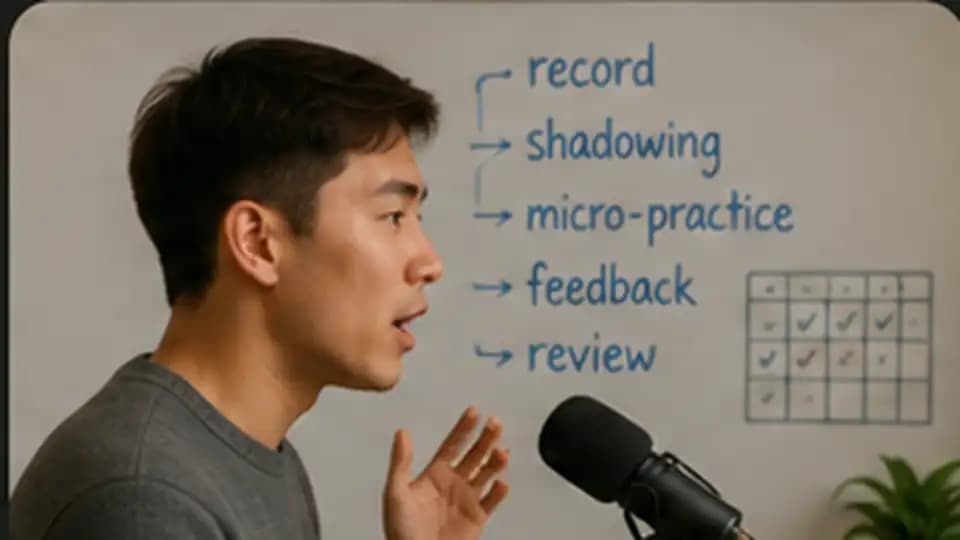
Language practice becomes much more useful when it ends with something you need to do: explain a problem at a shop, join a class discussion, check into a hotel, make small talk with a colleague, or ask a follow-up question without switching languages.
AI can help you rehearse that moment, but it should not pretend to certify your pronunciation or teach every phrase from memory. The useful result is a compact conversation kit: one clear goal, a few verified ways to express it, a short speaking rehearsal, repair phrases for when communication breaks down, and a correction log you can practise again.
Capability check — August 6, 2026: OpenAI says ChatGPT Voice supports spoken back-and-forth conversations on supported web and mobile experiences, with available options depending on plan, region, workspace settings, and app version. Voice transcripts may not exactly match what was said. ChatGPT Dictation returns an editable transcription before the message is sent. Study Mode is available across ChatGPT plans on web, iOS, and Android and can quiz users one question at a time; voice can be used with Study Mode where supported. A text-only version of this entire workflow also works without voice.
Before you start: choose one conversation with a finish line
Do not practise “speaking English” or “speaking Spanish” in general. Choose one situation you may realistically encounter in the next week.
Write four things:
- Situation: where the conversation happens;
- Result: what must be understood before it ends;
- Likely questions: two or three things the other person may ask;
- Boundary: information you will not share with the AI or the role-play.
For example:
- Situation: returning a faulty pair of headphones;
- Result: explain the fault and ask what return options are available;
- Likely questions: purchase date, proof of purchase, when the problem started;
- Boundary: no real receipt number, address, payment details, or employee name.
Use fictional or redacted details. Do not upload another person’s voice message without permission. For medical, legal, immigration, emergency, or similarly high-stakes communication, use a qualified interpreter or the relevant official service rather than relying on an AI rehearsal.
1. Build a three-level phrase ladder
Outcome: A small set of expressions you can actually remember: one simple version, one natural version, and one more polite or formal version for each important message.
Best fit: Learners who know what they want to say but either translate word for word or search for one “perfect” sentence and freeze when they forget it.
Inputs and tools: Your conversation card, your current level, and a text-capable AI assistant. Add a trusted course book, dictionary, teacher note, or official phrase guide when exact wording or local usage matters.
Steps
- List the four to six meanings you must communicate—not complete sentences yet.
- Ask for three ways to express each meaning: simple, natural, and polite/formal.
- Require the assistant to explain any difference in tone or situation.
- Remove vocabulary you would not recognise under pressure.
- Verify unusual phrases with a trusted dictionary, teacher, fluent speaker, or reliable local source.
- Choose one default sentence and one backup sentence for each meaning.
Useful prompt:
I am a [level] learner preparing for [specific situation] in [country or variety of the language]. These are the meanings I must communicate: [list]. For each meaning, give me a simple version, a natural everyday version, and a polite or formal version. Keep each sentence short enough to say from memory. Explain any important tone or regional difference. Do not invent local rules, rights, promises, or facts about the situation. Mark wording that a fluent speaker should verify.
Time and cost: About 8–10 minutes. This can be done in an ordinary text chat; no voice feature or specialist language subscription is required.
Privacy, accuracy, and copyright limits: AI may generate grammatically possible wording that sounds unusual, too direct, overly formal, or wrong for the region. Verify the phrases that matter most. Do not paste large copyrighted textbook sections or paid course transcripts merely to imitate their style.
2. Use dictation as a recognition check—not a pronunciation score
Outcome: A short list of words or sentence boundaries that the speech system repeatedly misunderstands, giving you specific items to practise.
Best fit: Learners who can read their prepared sentences but do not know which parts become unclear when spoken at normal speed.
Inputs and tools: Six short lines from the phrase ladder and ChatGPT Dictation or another speech-to-text tool that lets you inspect the transcription before sending.
Steps
- Record one prepared sentence at a comfortable speed.
- Read the returned transcript before sending it.
- Mark only differences that change meaning, omit an important word, or repeatedly split the sentence incorrectly.
- Try the same sentence once more with a slightly slower pace and clearer word boundaries.
- If the same word is still misheard, isolate it in a short phrase rather than repeating it louder.
- Keep the original wording when the transcript is wrong but a fluent listener confirms your speech is clear.
Useful interaction pattern:
I will dictate six sentences one at a time. After each transcript, compare the recognised text with my intended sentence. Identify only differences that could change the listener’s understanding. Do not assign a pronunciation score or claim that my accent is correct or incorrect. Group repeated problems into sounds, stress, word endings, or pacing, and give me one short practice phrase for each.
Time and cost: About 8 minutes. A free fallback is to use any built-in phone dictation tool and compare the text manually.
Privacy and accuracy limits: Speech recognition is affected by microphone quality, background noise, connection quality, accent coverage, and the system itself. A correct transcript does not prove natural pronunciation, and an incorrect transcript does not prove a human listener would fail to understand you. Treat it as one noisy test, not an accent diagnosis.
3. Run a six-turn rehearsal without rescue
Outcome: One realistic attempt at completing the conversation while handling an unexpected question, a misunderstanding, and a request for clarification.
Best fit: Learners who perform well when reading a script but lose the thread when the other person interrupts or asks something slightly different.
Inputs and tools: ChatGPT Voice, Study Mode with voice where available, or a text role-play. Give the AI only the fictional scenario, your level, and the role it should play.
Steps
- Tell the assistant who it is playing and what information that character knows.
- Ask it to speak at a natural but manageable pace and ask one question at a time.
- Tell it not to correct, translate, praise, or finish your sentence during the first six turns.
- Require one realistic misunderstanding and one question you did not prepare for.
- Complete the conversation using your phrase ladder and repair phrases.
- After six turns, stop the role-play and summarise whether the practical goal was achieved.
Useful interaction pattern:
Rehearse [situation] with me in [language]. You are [role]. I am approximately [level]. Ask one question at a time and wait for my complete answer. During the first six turns, do not translate, correct me, suggest vocabulary, praise me, or finish my sentence. Include one mild misunderstanding and one reasonable unexpected question. Stay within the fictional details I provide. After six turns, stop and ask me to state the final outcome in one sentence.
Time and cost: About 10–12 minutes. OpenAI says Study Mode is available across ChatGPT plans; voice options and limits vary. The free text-only route is to type each response and ask the assistant to follow the same six-turn rule.
Privacy and accuracy limits: An AI role-play cannot reproduce a real person’s accent, impatience, background noise, social status, or local procedure reliably. Its response may be too cooperative or unrealistically difficult. Voice transcripts are not verbatim records, so check any quoted mistake against what you remember saying.
4. Build a repair kit and correction log
Outcome: Five reusable phrases for recovering when communication breaks down, plus a short error log focused on meaning rather than every small grammar mistake.
Best fit: Learners who can begin a conversation but switch languages immediately after missing one word or being misunderstood once.
Inputs and tools: The rehearsal transcript, your intended meanings, and the original phrase ladder. A text assistant or spreadsheet is enough.
Steps
- Correct obvious transcription errors before analysing the conversation.
- Separate problems into four groups: meaning changed, meaning unclear, understandable but unnatural, and minor error with no practical effect.
- Keep only three to five high-value corrections from the session.
- Create repair phrases for asking someone to repeat, slow down, rephrase, confirm a detail, or let you try again.
- Rewrite each failed answer in words you already know.
- Repeat the difficult turn once without looking, then schedule a second attempt the next day.
Useful prompt:
Compare this rehearsal transcript with my intended conversation goal and phrase ladder. Quote the exact line before commenting. Classify each issue as: meaning changed, meaning unclear, understandable but unnatural, or minor and not worth practising now. Select no more than five corrections. Then create five short repair phrases for repetition, slower speech, rephrasing, confirmation, and trying again. Do not infer pronunciation details that the transcript cannot prove.
Time and cost: About 10 minutes. A basic text chat and a notes app are sufficient.
Privacy, accuracy, and copyright limits: The transcript may contain errors, and the assistant may “correct” a valid regional form into its preferred variety. Keep corrections that improve communication and match the variety you are learning. A teacher or fluent speaker is more reliable for subtle tone, pronunciation, and cultural judgement.
A practical 40-minute session
| Activity | Time |
|---|---|
| Define the situation and build the phrase ladder | 10 minutes |
| Run the dictation recognition check | 8 minutes |
| Complete the six-turn rehearsal | 12 minutes |
| Build the repair kit and correction log | 10 minutes |
The session should finish with a small page containing:
- one real conversation goal;
- four to six default phrases and backup versions;
- two or three words or rhythm problems to revisit;
- five repair phrases;
- no more than five corrections;
- one date for the next rehearsal.
That is more useful than collecting fifty generated expressions you will never say.
Keep the practice reliable
Change only one variable in the next rehearsal. Make the other person busier, add one missing detail, change the level of formality, or shorten the time available. Do not generate an entirely new script every day; repeat the same core conversation until you can recover from small changes.
For privacy, use invented names, dates, account details, workplaces, and addresses. OpenAI’s Data Controls allow signed-in users to turn off “Improve the model for everyone.” Temporary Chats are not saved in history, do not create memories, are not used to train models, and are deleted from OpenAI’s systems after 30 days. Voice and dictation have their own audio-retention details, so review the current product settings before recording sensitive speech.
Those controls do not make it appropriate to record other people secretly or upload confidential calls. Practise with your own voice and synthetic situations.
Conclusion
AI language practice works best when it prepares you for one concrete interaction rather than producing endless generic conversation topics.
Build a short phrase ladder, use dictation as an imperfect recognition check, complete a rehearsal without being rescued, and keep only the corrections that affected understanding. Most importantly, practise how to recover. Real conversations do not require flawless grammar; they require enough language to continue after something goes wrong.