
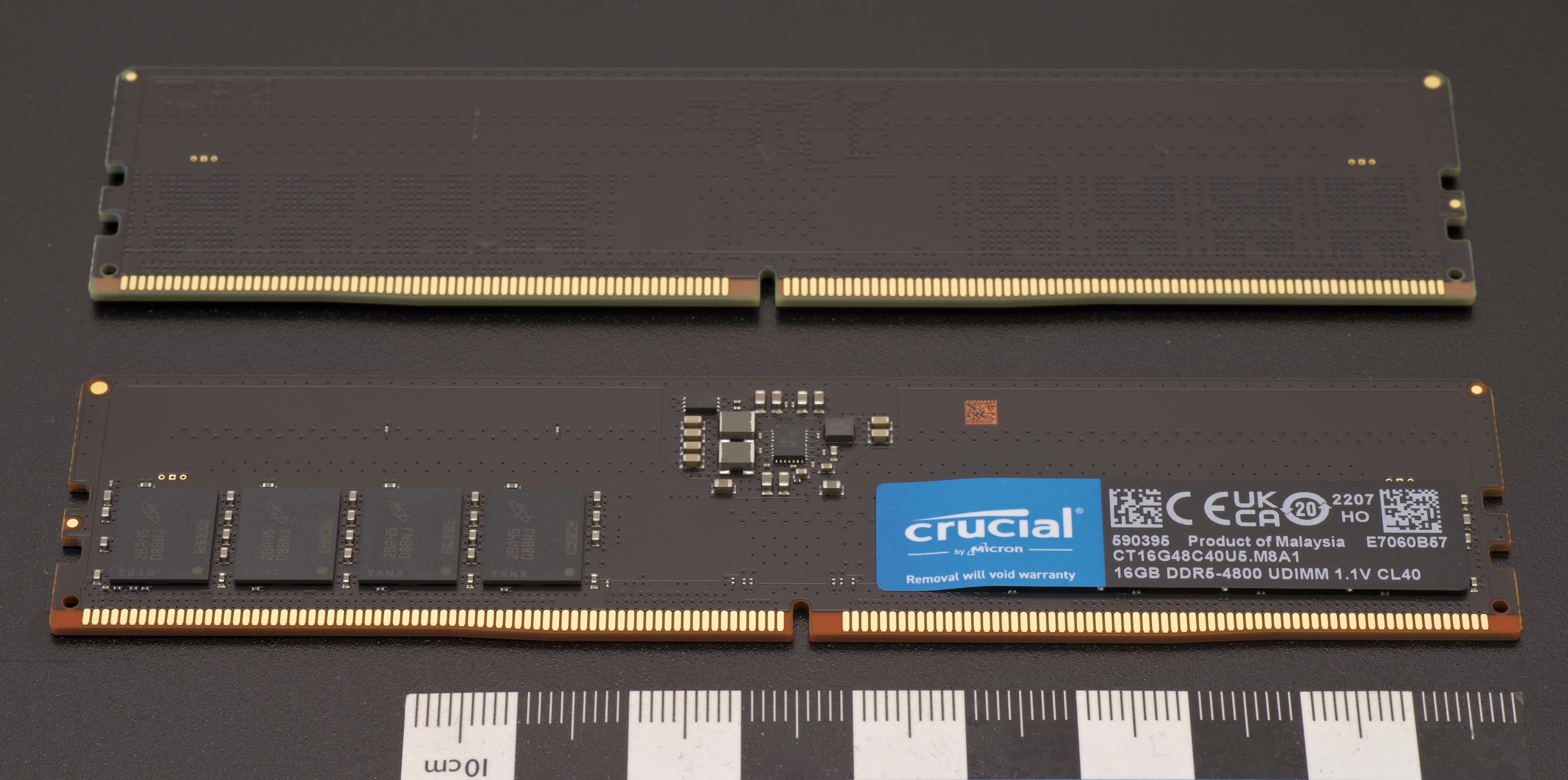
If a laptop, mini PC, RAM kit, or SSD feels unusually expensive in 2026, there is a real supply-chain reason behind it.
The short version is:
AI infrastructure is consuming a much larger share of the memory industry's attention and output, while server builders are also demanding more conventional DRAM and enterprise SSD capacity. That has tightened supply for consumer memory and storage and raised manufacturers' component costs.
But the simple version—“AI companies bought all the RAM”—is too crude.
The memory inside an AI accelerator is not the same product as the DDR5 or LPDDR5X in a normal PC. SSD NAND is a separate market again. The connection happens through shared manufacturing capacity, supplier priorities, capital spending, packaging resources, and a huge increase in data-center demand across several types of memory at once.
As of September 5, 2026, the consumer side is showing two things simultaneously: manufacturers are still under significant memory-cost pressure, while weak end-user demand is starting to limit how much of those increases the market can absorb.
That means the useful question is not simply “Will prices go up?”
It is:
Which parts are exposed, how urgent is the purchase, and how expensive would it be to choose the wrong memory configuration today?
What is actually in short supply?
“Memory” gets used as one word for several different products.
For a PC buyer, three categories matter most:
| Component | Where you usually see it | What it does | Why 2026 supply matters |
|---|---|---|---|
| DDR5 / LPDDR5X DRAM | Desktops and laptops | Working memory for apps and the operating system | Consumer DRAM competes with higher-value server and AI-related memory for supplier capacity and investment |
| HBM | AI accelerators and high-end GPUs | Extremely high-bandwidth memory close to the accelerator | AI demand makes HBM strategically valuable and encourages suppliers to prioritize it |
| NAND flash | NVMe SSDs, phones, storage devices | Persistent storage | AI servers and data centers are consuming much more enterprise SSD capacity, tightening NAND supply |
The distinction matters because a laptop does not normally contain the same HBM package used beside an AI accelerator.
Instead, AI demand changes what memory manufacturers choose to produce and where they put their next unit of capacity.
TrendForce describes the dynamic directly: major DRAM manufacturers have prioritized HBM and high-end server DRAM, while limited fabrication capacity has squeezed general server and consumer DRAM. On the storage side, it says NAND suppliers have been allocating more output toward enterprise SSDs as AI inference and large-scale data-center deployments expand.
So the pressure is real, but indirect.
Why AI changes the economics of ordinary RAM
A memory manufacturer has finite production equipment, wafers, engineering resources, packaging capacity, and capital expenditure.
If one segment offers unusually strong demand and higher strategic value, suppliers naturally push more resources toward it.
In 2026, that segment is AI infrastructure.
Micron, for example, said in March that it had started volume shipments of 36GB 12-layer HBM4 for Nvidia's Vera Rubin platform. The same announcement highlighted new data-center SSDs and high-capacity SOCAMM2 memory for AI and HPC systems.
That does not prove that every HBM wafer directly replaces a consumer DDR5 wafer one-for-one. Manufacturing flows differ, and the supply chain is more complicated than that.
What it does show is where the industry's fastest-growing engineering and capacity priorities are moving.
TrendForce's broader supply analysis makes the consumer impact clearer: with the largest DRAM suppliers prioritizing HBM and high-end server products, the available supply for ordinary DRAM has tightened.
This is why a boom in $30,000-plus AI accelerators can eventually show up as a higher configuration price on a completely ordinary laptop.
SSDs are being pulled by AI too
The storage side has its own version of the same story.
AI systems do not keep everything in HBM forever. Model weights, datasets, checkpoints, embeddings, logs, cached data, and inference workloads all create enormous storage demand.
TrendForce's September 2 NAND market bulletin said third-quarter 2026 contract prices had been finalized against strong demand from server OEMs and cloud providers. It also noted an important counterpoint: the consumer spot market remained sluggish because end-user demand was weak.
That split is useful.
It means enterprise buyers can keep the upstream NAND market tight even while consumers resist expensive SSD upgrades.
Earlier, TrendForce forecast third-quarter NAND Flash contract prices to rise 10–15% quarter over quarter, with AI inference and large-scale data centers as key demand drivers. It also said vendors were allocating more capacity to enterprise SSD production.
In practice, that can produce a strange retail market: the underlying component cost is high, but individual SSD models still go on sale because brands and retailers have different inventories, purchase contracts, and promotional needs.
So “NAND is expensive” does not mean “every SSD gets 15% more expensive on the same day.”
The pressure has already reached notebook makers
This is no longer just a semiconductor-industry forecast.
On September 4, 2026, TrendForce said notebook brands were still facing persistent increases in DRAM and SSD costs. It said those rising component costs had encouraged manufacturers to secure parts earlier and were continuing to put pressure on notebook economics even as CPU supply improved.
A useful way to understand the effect is through the bill of materials.
In March, TrendForce modeled a mainstream notebook and estimated that DRAM plus SSDs, which would normally represent roughly 15% of its bill-of-materials cost, could exceed 30% after the sharp memory increases seen by early 2026.
That was a scenario model, not a prediction that every laptop would receive the same retail price increase. Vendors can absorb costs, reduce margins, change suppliers, lower default specifications, or promote different models.
Still, it explains why a computer with an otherwise familiar CPU and display can suddenly become much more expensive once the RAM or SSD tier changes.
Real products show how uneven the market is
The most useful evidence comes from companies actually buying these parts.
Framework has maintained a running public log of its 2026 memory and storage costs. The pattern is not a clean straight line.
In July, Framework said a new quote for the LPCAMM2 memory used in its Laptop 13 Pro was more than double the cost of the inventory it had previously purchased. At the same time, the company said some 48GB DDR5 module costs had fallen enough for it to reduce prices, while 16GB module costs had risen. Some SSD capacities also became cheaper while others became more expensive.
That is exactly what a volatile supply-constrained market looks like.
There is an industry-wide direction, but inventory timing and specific part availability still matter enormously.
Raspberry Pi provides another concrete example. In April, it said the LPDDR4 DRAM used in Raspberry Pi 4 and 5 had risen roughly seven-fold in its own purchasing experience over the previous year, forcing price increases on higher-memory models. It responded by adding a lower-memory 3GB Raspberry Pi 4 and explicitly encouraged customers to right-size memory rather than automatically buying the largest configuration.
The lesson is not that every memory product rose seven-fold. The lesson is that manufacturers exposed to a particular DRAM type can face dramatically different cost shocks.
So, should you buy a laptop now?
There is no universal “buy immediately” answer.
A better decision rule is to separate urgency, upgradeability, and memory sensitivity.
Case 1: You need a laptop in the next month or two and the RAM is soldered
Buying when you find the right configuration at an acceptable total price is reasonable.
The important part is choosing enough memory up front.
Soldered LPDDR cannot normally be upgraded later. If the 16GB model is barely sufficient today and the 32GB version is affordable, waiting for memory prices to normalize does not help after you have already bought the smaller machine.
Do not focus only on the size of the current RAM premium. Compare the cost of replacing the whole laptop early because the memory ceiling became restrictive.
Case 2: You want a desktop or an upgradeable laptop
Be more price-sensitive.
If the machine uses replaceable DDR5 SO-DIMMs, DIMMs, or an upgradeable memory module, the initial configuration matters less.
Compare three prices:
- the manufacturer's RAM upgrade price;
- a compatible retail memory kit;
- the base machine with no unnecessary memory upgrade.
In a volatile market, the cheapest route can change from week to week.
Framework's own 2026 updates are a good example: it has at times explicitly told DIY buyers to purchase retail RAM elsewhere when outside prices were lower.
Just verify compatibility, supported capacity, return policy, and warranty implications before assuming any module will work.
Case 3: You mainly need more SSD space
Buy for a real storage need, not because you fear every SSD will disappear.
NAND supply remains pressured, but consumer demand is weak enough that promotions and model-specific discounts still exist.
For a desktop or laptop with a replaceable M.2 drive, waiting for a good price on the exact capacity you need can still make sense.
For a sealed device where storage cannot be upgraded, the same logic as soldered RAM applies: the cost of being trapped with too little storage may be greater than today's premium.
Case 4: Your current computer still does everything you need
Waiting remains perfectly rational.
The supply situation is tight, but it is not evidence that every consumer device must get more expensive every month.
TrendForce is already seeing weak consumer demand cap the pace of contract-price increases, and its September NAND bulletin described the consumer spot market as sluggish.
A functioning machine gives you the luxury of waiting for a promotion, a better configuration, or more visible evidence that component pricing is easing.
A simple buy-now framework
Use this checklist before blaming the entire purchase decision on “RAMageddon.”
| Question | If the answer is yes | What to do |
|---|---|---|
| Do you need the computer within 4–8 weeks? | Timing matters more than forecasting memory prices | Shop current total system prices and buy when the configuration is good |
| Is the RAM soldered? | A bad choice cannot be fixed later | Prioritize enough RAM over a small CPU/GPU upgrade you may not need |
| Is the memory replaceable? | You have flexibility | Compare OEM and retail module pricing before configuring |
| Is the SSD replaceable? | Capacity can be added later | Avoid paying a huge factory storage premium unless it is competitive |
| Is your current device still adequate? | You can wait without productivity cost | Keep watching promotions rather than trying to call the exact memory-market top |
| Are you buying huge capacity “just in case”? | Volatility can punish overbuying | Size memory and storage around realistic workloads |
The key idea is option value.
Upgradeable hardware gives you options later, so you can afford to be patient. Soldered memory removes those options, so buying the right capacity now matters more than predicting next quarter's DRAM contract price.
What not to assume
“AI PCs are expensive because they use HBM”
Usually false.
Mainstream laptops generally use DDR- or LPDDR-family system memory. The AI connection is mostly upstream supply allocation and broader server demand, not a tiny HBM stack hidden inside an ordinary notebook.
“If contract prices rise 15%, my laptop will rise 15%”
Also false.
Component contracts, old inventory, currency, promotions, vendor margins, product mix, and competitive pricing all sit between a memory supplier and the retail price.
“Every RAM capacity should move together”
No.
Different densities, formats, suppliers, and inventories can move differently. Framework's 2026 updates have repeatedly shown some capacities falling while others rise.
“Waiting definitely means cheaper hardware”
There is no evidence strong enough to promise that.
New manufacturing capacity takes time, AI infrastructure demand remains strong, and suppliers continue to prioritize high-value server products. But weak consumer demand can also limit price increases and create retail deals.
Both forces are operating at once.
What to watch next
Four signals matter more than dramatic headlines.
1. Fourth-quarter DRAM and NAND contract pricing
If contract increases keep moderating, that would suggest the market is moving from acute shortage toward a less extreme balance—even if prices remain high in absolute terms.
2. Default laptop configurations
Watch whether mainstream machines begin shipping with less RAM or storage at the same price, or whether higher-memory configurations carry unusually large premiums.
Specification cuts can hide inflation that does not appear as a higher sticker price.
3. OEM pricing updates
Manufacturers that publicly discuss component costs—Framework and Raspberry Pi are unusually transparent examples—provide a useful real-world check on semiconductor forecasts.
4. Enterprise SSD and AI-server demand
If server and cloud buyers continue absorbing new NAND supply faster than production expands, consumer SSD pricing will have less room to normalize quickly.
Conclusion
AI is affecting the price of ordinary computers, but not because a data center is literally buying the same RAM stick that would have gone into a laptop.
The real chain is more interesting:
AI accelerators increase demand for HBM; AI servers increase demand for server DRAM and enterprise SSDs; suppliers prioritize those high-value markets; limited manufacturing capacity tightens consumer DRAM and NAND supply; device makers eventually pay more for RAM and storage.
As of September 5, 2026, that pressure is still visible. TrendForce says notebook makers continue to face rising DRAM and SSD costs, while its latest NAND update also shows weak consumer demand restraining the market.
For buyers, that argues against both panic and complacency.
If a needed laptop has soldered memory, choose the capacity you will actually need and judge the whole-system price, not an imagined future RAM price. If the machine is upgradeable, keep the flexibility and compare component prices separately. If the current computer still works, there is no strong reason to manufacture urgency.
The best response to a volatile memory market is not guessing the exact top.
It is buying hardware in a way that leaves as few expensive regrets as possible.
Sources
Checked September 5, 2026:
- TrendForce — Improved CPU Supply Narrows 2026 Global Notebook Shipment Decline, but Brands Still Face Heavy Cost Pressure (Sept. 4, 2026)
- TrendForce — NAND Flash Market Bulletin, Sept. 2, 2026
- TrendForce — AI Server Demand Continues to Support Memory Prices in 3Q26 (July 3, 2026)
- TrendForce — Memory Wall Bottleneck: AI Compute Sparks Memory Supercycle
- TrendForce — Rising Memory and CPU Prices Could Push Mainstream Notebook Prices Up (March 10, 2026)
- Micron — HBM4, PCIe Gen6 SSD and SOCAMM2 production announcement (March 16, 2026)
- Framework — Navigating the volatile silicon market: memory and storage pricing updates
- Raspberry Pi — A new 3GB Raspberry Pi 4 and more memory-driven price increases (April 1, 2026)
- Wikimedia Commons — DDR5 SDRAM cover photo by Rainer Knäpper / Smial, Free Art License