
A 14.5% fall in one day is not a normal red candle. It is the kind of move that makes shareholders open their brokerage app, close it, and then open it again five minutes later—as if the number might apologise.
Tesla’s second-quarter report created exactly that kind of confusion. Revenue was strong. Deliveries were strong. Then profit, margins and cash flow walked into the room and ruined the mood.
Tesla closed at $319.69 on Thursday, July 23, down 14.52%, and slipped again to $313.03 on Friday. At roughly 10:30 a.m. ET on Monday, July 27, the shares were trading around $307–309, down another 1%–2%, even while the wider U.S. market was rising. In other words, the instant heroic rebound had not arrived yet. (Monday price update; broader market context)
Market-data note: The Monday price above is an intraday snapshot and will change. Closing prices are through Friday, July 24, 2026. The reaction analysis below is a qualitative sample of public discussions, reported retail flows, fund trades and options activity—not a scientific opinion poll.
First, what actually went wrong?
The quarter was a classic Tesla headache: the top line looked healthy, while the bottom line looked considerably less healthy.
| The encouraging part | The part investors could not ignore |
|---|---|
| Revenue reached about $28.24 billion, up 26% year over year | Adjusted EPS was $0.33, well below expectations around $0.53–$0.55 |
| Tesla delivered a second-quarter record 480,126 vehicles | Operating income fell 57% to about $398 million |
| Energy-storage deployments reached 13.5 GWh | Operating margin fell to 1.4% |
| Tesla still has a large cash and investment balance | Free cash flow turned negative by roughly $1.09 billion |
| Robotaxi, Cybercab, Optimus and AI investment continued | Quarterly capital expenditure jumped to about $5.79 billion, with more than $25 billion expected for 2026 |
Tesla’s own delivery release confirms the record vehicle volume, while its financial release and subsequent reporting show how sharply spending and weak profitability outweighed that good news. (Tesla deliveries; Tesla financial-results announcement; earnings breakdown)
The market’s message was basically:
Nice revenue. Now show us the profit—and explain when all this spending starts paying back.
That is where investors split into five very different camps.
Camp 1: “I’m buying the dip”
The selloff looked frightening on the chart, but retail investors did not all run for the exit.
Vanda Research data reported by Bloomberg showed about $42 million in net retail purchases on July 23, making Tesla the most heavily bought stock among retail traders that day. ARK Invest went further, buying more than 160,000 Tesla shares across several funds after the plunge. (Retail-flow report; ARK purchase report)
The dip-buying argument is straightforward: Tesla is deliberately spending through current profits to build much larger businesses in autonomy, robotics, AI chips, energy and manufacturing.
People in this camp are not really buying the current operating margin. They are buying the possibility that Tesla eventually becomes much more than a car company.
To them, negative free cash flow is not automatically a disaster. It may be the bill for building Robotaxi, Cybercab and Optimus at scale.
The uncomfortable part is that the bill is real, while the future profit is still a forecast. This camp wins if those projects begin producing measurable revenue and attractive margins. It loses if the timelines keep moving while the cash burn keeps growing.
Camp 2: “I’m holding, but my wallet is staying closed”
This may be the most relatable group.
In one long-term Tesla investor discussion, a shareholder said they had not sold but had stopped buying and begun easing into Nvidia instead. Other holders described Tesla as a judgment-based long-term bet rather than something that can be neatly calculated from next quarter’s earnings. (Long-term shareholder discussion)
Their position is not exactly bullish and not exactly bearish. It is more like:
I still believe the story, but I would quite like the story to start providing receipts.
They do not want to panic-sell after a brutal drop. At the same time, they do not want to average down automatically just because the share price is lower.
That distinction matters. Not selling is not the same as having fresh conviction. Sometimes holding simply means waiting for better evidence before making the next decision.
The evidence this group wants is usually practical: improving automotive margins, positive free cash flow, a clearer Robotaxi rollout, real Optimus production and fewer timelines built around words such as “soon.”
Camp 3: “I still believe, but this position is getting ridiculous”
Some longtime shareholders are trimming rather than choosing between two dramatic options: hold every share forever or sell everything immediately.
In the same investor discussion, one shareholder who had owned Tesla since 2014 said they had sold roughly one-third of their original position to diversify while keeping the rest. Another longtime holder said they sold a substantial percentage because the personal consequences of a major Tesla collapse mattered more than preserving maximum upside. These are anecdotes, not representative statistics, but they reveal an important concern: position size. (Shareholder discussion)
A 14.5% fall is annoying when Tesla is 3% of a portfolio. It can be life-changing when Tesla is 50% of it.
This group may still believe Tesla has a bright future. It simply does not want one company deciding the future of a house deposit, retirement plan or family savings.
Conviction does not receive a special exemption from arithmetic. A stock can eventually recover and still be too large for someone’s real-life risk tolerance today.
For these investors, trimming is not necessarily a vote against Tesla. It is a vote for sleeping at night.
Camp 4: “Come back when there is proof”
This group is tired of valuing demonstrations, promises and enormous potential. It wants operating evidence.
After the earnings call, several analysts cut their Tesla price targets. The disagreement remained huge: bullish analysts still saw autonomy and robotics as enormous opportunities, while sceptics focused on weak current earnings, high valuation and rising capital intensity. The quarter did not settle that argument. It made the gap between the two sides even wider.
Public investor discussions show the same tension. Some shareholders see Tesla’s manufacturing scale and AI ambition as a rare long-term advantage. Others believe too much future success is already included in the valuation, especially when Robotaxi and Optimus face serious technical, regulatory and competitive risks. (Q2 investor discussion; long-term debate)
The proof-first crowd wants numbers such as:
- Robotaxi revenue, utilisation and profit per vehicle
- A repeatable record of safe autonomous miles
- Real geographic expansion rather than another launch date
- Optimus production volumes and paying external customers
- Improving automotive margins
- Positive free cash flow while investment remains high
Until those numbers arrive, this group sees the fall as a warning—not automatically a bargain.
Camp 5: “Forget 2035. What happens by Friday?”
Then there are the volatility traders.
During Thursday’s selloff, around 770,000 call contracts and 695,000 put contracts had traded by late morning—roughly twice the normal intraday options volume. The most active contract was a weekly $330 put, where new bearish positions were being opened. (Options activity)
At the same time, Reddit’s earnings thread contained people shouting for Tesla calls while others immediately suggested puts. That is more or less the entire Tesla internet compressed into one screen. (Earnings-trader discussion)
These traders are not mainly asking whether Tesla becomes the world’s biggest robotics company in ten years. They are asking whether the stock is oversold, whether shorts will take profits, whether dip buyers will create a squeeze, or whether another analyst cut will send it lower tomorrow.
That can produce huge wins. It can also produce very fast losses, because options add timing risk and leverage to a stock that is already extremely volatile.
A failed short-term trade can easily turn into an accidental “long-term investment.” That particular transformation has happened to more portfolios than anyone likes to admit.
What are investors really arguing about?
The debate is not simply whether Tesla had a good or bad quarter. The bad parts of the quarter are fairly clear.
The real argument is what kind of company Tesla should be valued as.
Tesla as a vehicle and energy company
This view focuses on today’s revenue, margins, profit and free cash flow.
From that angle, a 1.4% operating margin and negative free cash flow are difficult to combine with one of the market’s most demanding valuations. Robotaxi and Optimus may become valuable, but this group does not want to pay the full future price before the businesses exist at scale.
Tesla as an AI, autonomy and robotics platform
This view treats the current car business as the launchpad rather than the final product.
Supporters believe software, autonomous transport, robotics, AI chips and energy infrastructure could eventually be far larger and more profitable than manufacturing cars. From that angle, judging Tesla mainly through one quarter’s automotive and operating margins misses the point.
Tesla as both—which is where things get awkward
The middle view accepts the future opportunity but remembers that somebody has to fund it.
Tesla’s current businesses need to generate enough cash to carry the company through an expensive buildout. A strong long-term story does not make capital expenditure free, and a large cash balance does not guarantee that every ambitious project earns a good return.
That tension is why two intelligent investors can study the same quarter and reach completely different conclusions.
Five questions for a confused Tesla holder
Before buying, selling or averaging down, these questions are more useful than staring at the red percentage for another hour.
1. Why did you buy it in the first place?
Was your thesis based on cars, energy, Full Self-Driving, Robotaxi, Optimus—or simply the belief that Tesla always bounces?
A lower price does not rescue a thesis that was never clear.
2. What would prove you wrong?
“Tesla always comes back” is not evidence. Neither is “Tesla is finished.”
Decide which measurable results would strengthen or break your thesis.
3. Is the position too large?
The sensible response can be completely different for someone with 3% of their portfolio in Tesla and someone with 60%.
4. How long can you genuinely wait?
A project can eventually succeed while the stock underperforms for years. Opportunity cost matters, especially when other businesses are already producing strong cash flow.
5. Are you investing or trading?
Buying because Tesla may dominate robotics in 2035 is an investment thesis.
Buying because the stock fell 14.5% and “has to bounce” is a trade. Mixing those plans is how the timeline quietly changes after the price moves against you.
My read: the fall was serious, but it did not answer everything
The selloff was not random. Tesla’s earnings quality weakened, profit missed badly, free cash flow turned negative and spending is accelerating. The market had real reasons to reprice the stock.
But one ugly quarter also does not prove Robotaxi, Optimus or Tesla’s wider AI strategy will fail. It proves that investors are being asked to pay today and wait for the result.
The continued weakness on Monday—despite a broader market rally—suggests price discovery may not be finished. That does not guarantee another collapse, but it is a decent reason not to treat the first lower price as automatic support.
The most honest conclusion is that Tesla has become an even more concentrated bet on execution. Dip buyers, patient holders, diversifiers, sceptics and traders are not merely looking at different charts. They are operating with different timelines, different position sizes and completely different definitions of success.
Do not let one giant red candle write your investment plan for you. The plan should have existed before the candle arrived.
Sources and image credit
Key sources include Tesla Investor Relations, the Tesla Q2 delivery release, Bloomberg reporting republished by The Economic Times, Schaeffer’s options data, and the linked public investor discussions.
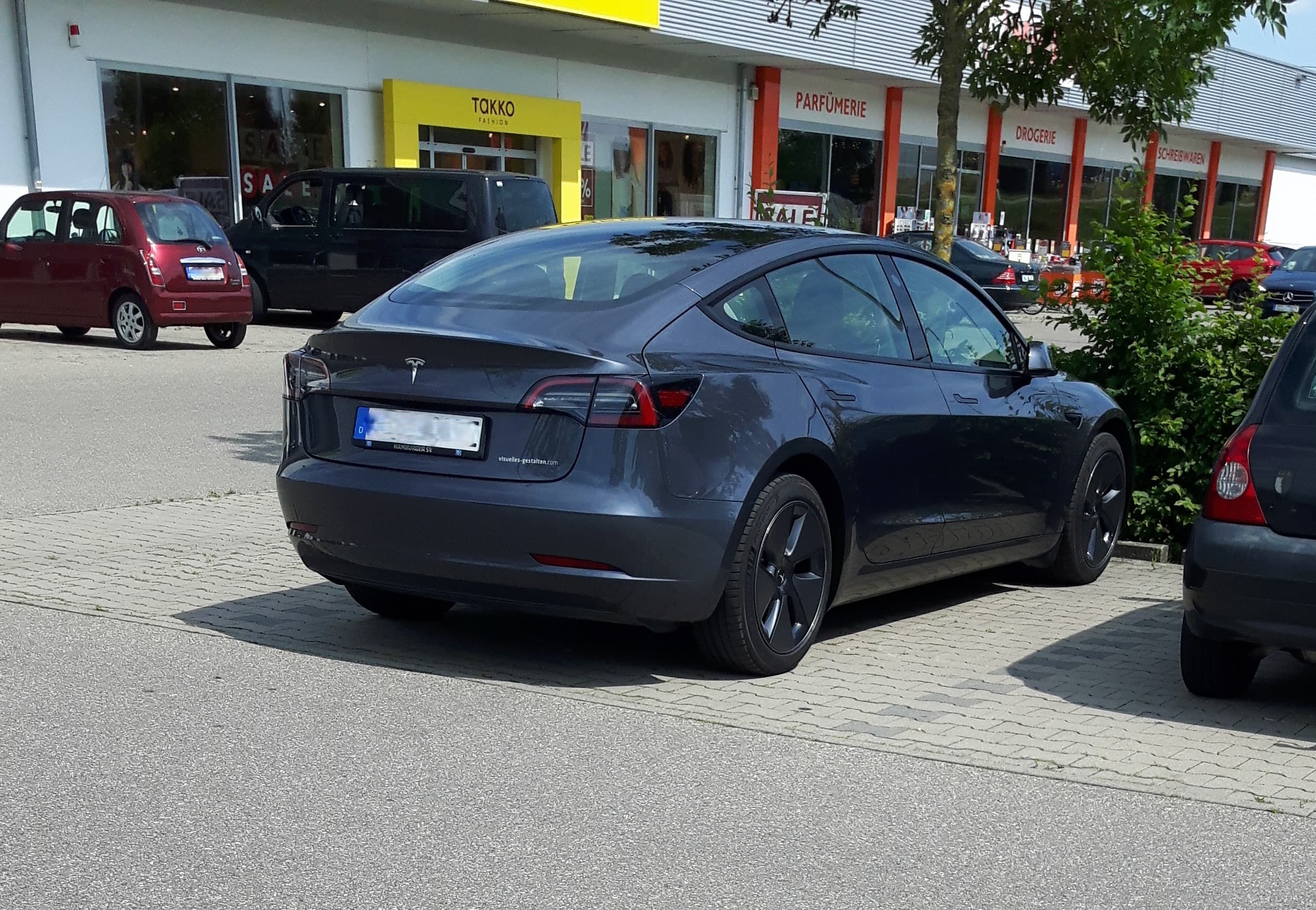
Cover photograph: “Tesla Model 3 152643” by Trop86, released under CC0.
This article is for educational and informational purposes only. It is not financial advice or a recommendation to buy, sell or hold Tesla shares or any other investment.