

I use both Claude Code and ChatGPT for coding. More specifically, when I talk about coding with ChatGPT in this post, I mostly mean Codex.
After using both, I don't think one is simply better than the other. They serve different purposes.
The biggest difference for me is not necessarily the quality of the code. It is the workflow.
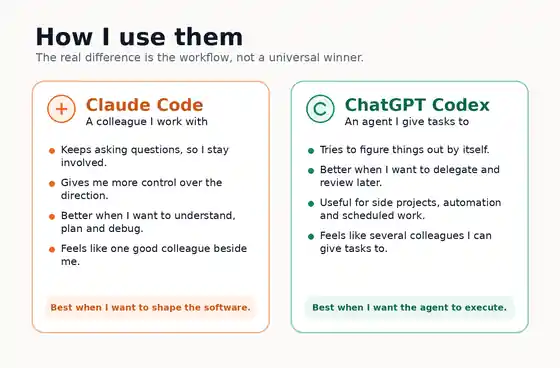
Claude Code feels like a colleague I work with.
Codex feels more like an agent I give tasks to.
Claude Code gives me more control
I use Claude Code when I want more control over what is happening, or when I feel that it performs better for a particular task.
Claude Code has more plugins and features, but the biggest difference is that it keeps talking to me. It asks questions instead of immediately deciding everything by itself.
Because of that, I feel more involved in the process.
This is especially useful when I already know what I want to build. At work, for example, I normally understand the product and have some idea of where the problem might be. I don't just want an AI agent to make changes. I want to investigate the issue, look at the code and understand the solution.
In those situations, Claude Code feels like one good colleague sitting next to me.
We look at the problem together. It asks me questions, I give it more context and we gradually shape the solution.
I also think Claude Code is better at planning before writing code. It lets me review the direction before it starts changing everything.
That makes me trust it more. It is not necessarily because it is always more intelligent, but because it talks to me and I can influence its decisions.
Codex is better when I want to delegate
I use Codex differently.
When I give the AI agent all the permissions and just want it to complete a task, Codex works well. I would describe this as closer to vibe coding.
Instead of sitting next to the AI and discussing every decision, I give it the driver's seat.
Codex often tries to figure things out by itself. Sometimes that is exactly what I want. I can give it a task and let it investigate the codebase, make changes and test the result without asking me about every small decision.
This is particularly useful for my side projects and automated tasks. I don't always want to sit there and work together with the AI. Sometimes I just want to describe the result and let the agent handle the work.
However, this also means Codex can make more unnecessary or incorrect changes, especially when I don't know exactly what I want.
When my own idea is vague, Codex fills in the missing details by itself. Sometimes it makes good decisions. Other times, it takes the project in a direction I didn't intend.
But I don't think this is always Codex's fault. When I polish my idea and explain clearly what I want, Codex is normally good enough.
For a small and clearly defined implementation, it can be really effective.
Small questions and small tasks are different
For small, specific questions about the code, I normally prefer Claude Code.
For example, when I want to look deeply into a piece of code, understand why it works in a certain way or discuss a small change, Claude Code's interactive workflow is better for me.
But a small question is different from a small task.
When I know exactly what needs to be changed and don't need to discuss it, Codex can complete that small task independently. I can describe the expected result and let it do the work.
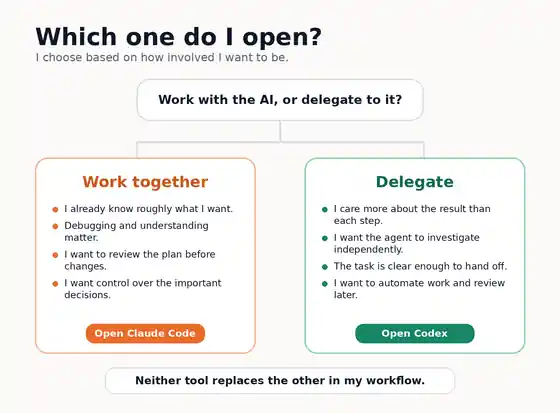
So my choice depends less on the size of the task and more on how involved I want to be.
Which one is better at debugging?
It depends.
When I want to be involved in the debugging process, Claude Code is better. I can share what I already know, question its assumptions and investigate the problem with it.
This is normally how I work professionally. Debugging is not just about finding something that makes the error disappear. I also want to understand the cause and make sure the solution doesn't create another problem.
But sometimes I have no idea what is happening and don't particularly want to investigate it myself. I just want an AI agent to explore the codebase, reproduce the problem and try to find a solution.
In that situation, Codex can be better because it is more willing to work through the problem independently.
Again, the difference is whether I want to work with the AI or delegate the work to the AI.
Which one understands the codebase better?
Honestly, I have no idea.
People often compare the models and try to decide which one understands large codebases better. In my experience, both are good enough.
I haven't found a reliable way to say that one always understands a project better than the other. The result depends on the repository, the task, the instructions and how much context I provide.
Both can produce impressive results, and both can misunderstand something.
Which one is faster for real work?
That depends on what we mean by “real work.”
Suppose I don't completely know what I am building and I am happy to give the driver's seat to the AI. In that case, Codex might be faster. It can make decisions by itself and move the project forward without waiting for me.
Of course, the risk is that I also don't really know what it is doing.
On the other hand, when I want to control the implementation and understand every important decision, Claude Code might be faster overall. It can prevent the AI from going too far in the wrong direction.
Speed is not only about how quickly an agent writes code. It is also about how much time I spend reviewing, correcting and reverting its work.
ChatGPT gives me more than coding
Claude Code is focused on software development.
ChatGPT is a more general-purpose product. I use it for coding, but I also use it for writing, research, image generation, scheduled tasks and automation.
That makes the value comparison complicated.
Previously, ChatGPT felt much cheaper to me because I could use Codex heavily as part of the same subscription. Recently, the amount of Codex usage I get has felt lower, so the price difference between the two services no longer feels as significant.
Still, ChatGPT gives me more types of tools within the same subscription.
I sometimes feel pressure to use both services because I pay a lot for them. But overall, I still think they are worth it. They save me time, and more importantly, they allow me to work in completely different ways depending on the situation.
Who should use Claude Code?
Claude Code is better suited to someone who wants to shape the software and develop a better understanding of it.
It works well when you already have technical knowledge, know roughly what you want and want to remain involved in the decisions.
It is not only about producing code. It is about discussing the implementation, investigating problems and improving the solution together.
That is why I use Claude Code more for my professional work. I normally know what needs to happen, and debugging and code quality are important.
Who should use ChatGPT and Codex?
Codex is a good fit when you want to delegate more of the work.
You may still want to become involved occasionally, but you don't necessarily want to discuss every step. You give it a task, let it work and then review the result.
ChatGPT also makes more sense when coding is only one of the things you want from an AI subscription. You can use it for general questions, writing, images, scheduled tasks and other kinds of automation.
Personally, I use Codex more for side projects and automated work. I use ChatGPT a lot, but I don't always want to sit down and work together with the AI. Sometimes I simply want to give it a task.
Neither one is always better
I often hear that Claude Code is simply better than Codex.
I understand why people say that. When you are actively working with it, Claude Code can feel more capable because it communicates with you and gives you more control.
But Codex can also be better.
It depends on the task and, more importantly, on how you want to use AI.
For my work, I use Claude Code because I know what I want to do, I care about debugging and I want to understand the changes. It feels like having one good colleague beside me.
For side projects and automation, I often use Codex. It feels more like having several colleagues who I can give tasks to and review later.
Those are two completely different ways of working.
Claude Code is not a replacement for ChatGPT because coding is only one part of what I use AI for. And ChatGPT is not a replacement for Claude Code because sometimes I don't want an agent to take over—I want a colleague to think with me.