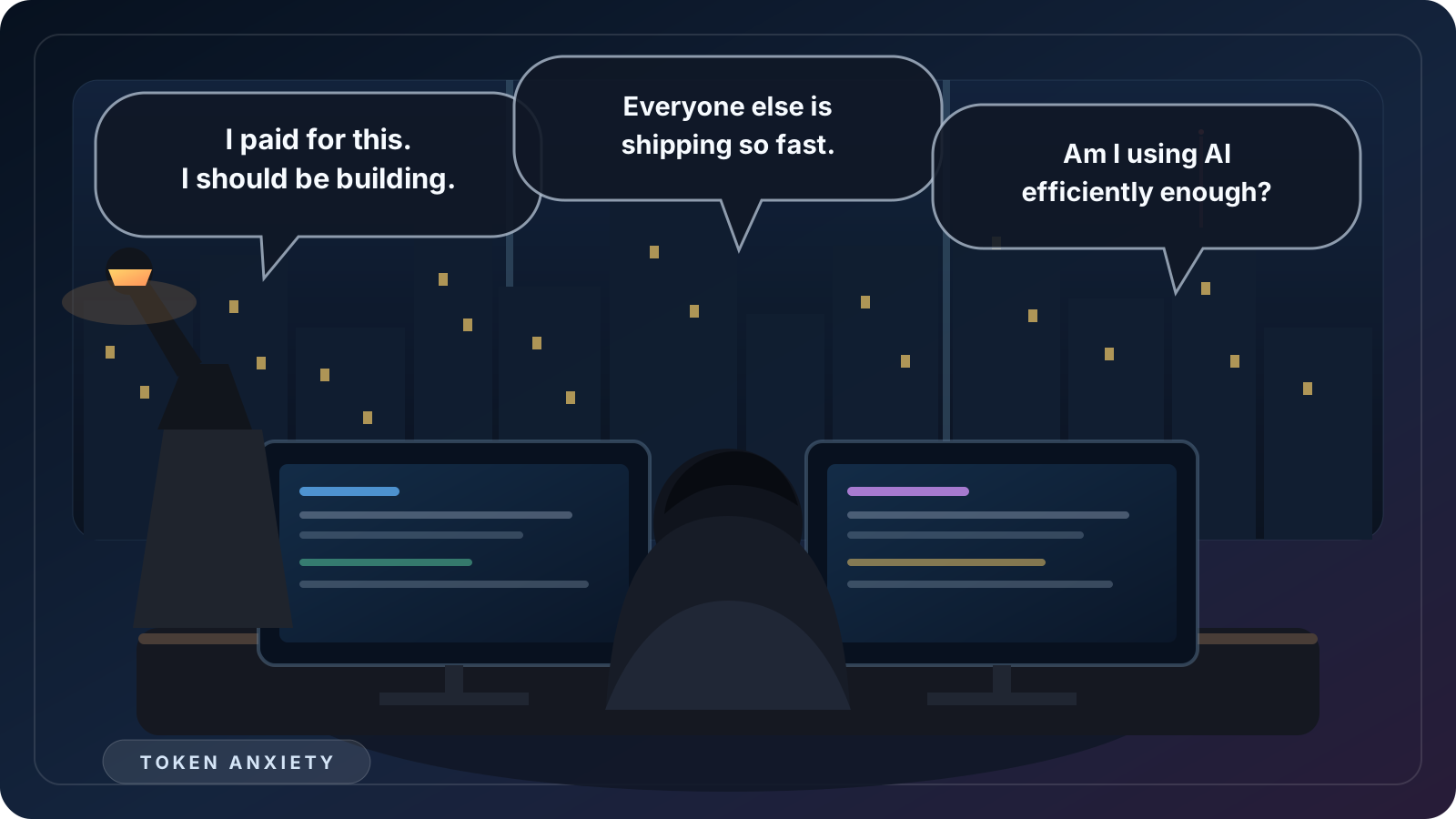
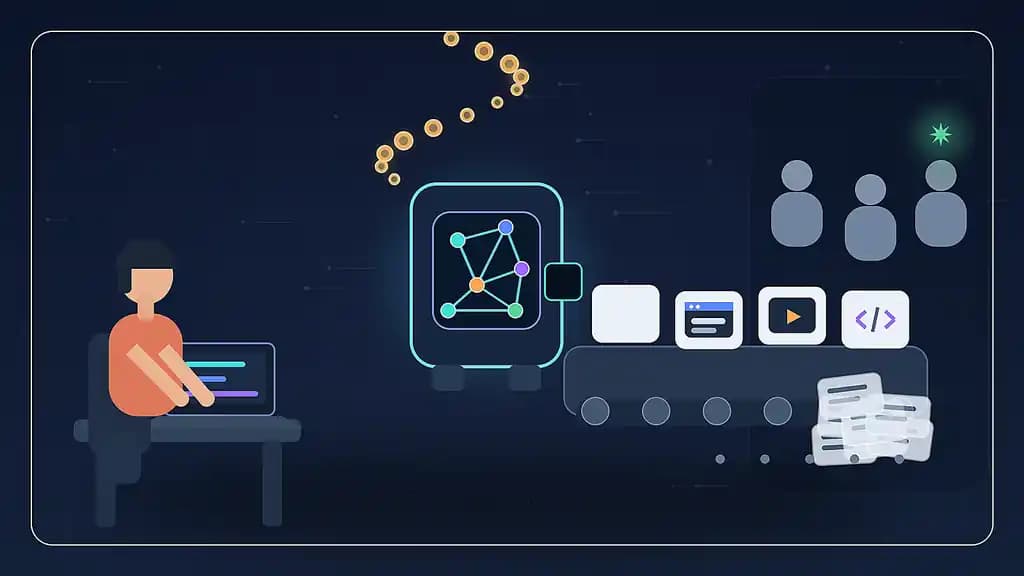
AI is supposed to give ordinary people leverage.
Tools such as ChatGPT, Claude Code, and Gemini can write software, generate content, research ideas, create marketing plans, and automate repetitive work. A single person can now attempt projects that previously required far more time or a small team.
That sounds incredibly valuable. And it is.
But I have started wondering about a different question:
After consuming all those tokens and generating all that work, what are we actually getting back?
I have used AI to build a language-learning app, produce marketing content, and work through business ideas. I have also uploaded 111 YouTube videos to promote the service.
At the time of writing, the channel has eight subscribers, and I suspect around five of them are fake.
AI helped me create more. It helped me move faster. It reduced the mental energy required to write code, produce content, and test ideas.
But it did not create demand.
And that difference matters.
AI Makes Production Easy, Not Success
When people ask how they can make money with AI, the answers are usually predictable:
- Start an AI-written blog.
- Generate social media content.
- Build a chatbot.
- Create a small software product.
- Sell AI-generated designs.
- Automate a service.
Technically, these are all possible.
The problem is that many other people can receive the same suggestions from the same tools.
AI does not merely help me create a blog. It helps everyone else create one too.
It does not merely help me build an app. It helps other developers and non-developers build competing apps.
It does not merely help me produce videos. It can generate scripts, captions, thumbnails, and ideas for almost anyone.
The result is not necessarily more opportunity. In many cases, it is simply more supply.
More articles. More apps. More newsletters. More videos. More automated services. More people competing for the same limited amount of attention.
When almost anybody can generate something, generation itself stops being an advantage.
The Machine Can Be Busy While I Remain Stuck
AI creates a strange feeling of progress.
I can open Claude Code, ask it to implement a large feature, and watch it modify dozens of files. I can ask ChatGPT to produce a business plan, a marketing strategy, and thirty content ideas. I can automate a workflow that continues generating things while I sleep.
There is always visible activity.
Lines of code are being written. Tokens are being consumed. Documents are appearing. Tasks are being completed.
But visible activity is not necessarily progress.
I could let AI generate 100,000 lines of code for a product that nobody wants. I could publish hundreds of articles that nobody reads. I could build a complicated automated business around an idea that never had real demand.
Eventually, I might throw the entire project away.
The AI still completed its task. The provider still processed the request. The output still existed.
But what did I gain?
Perhaps I validated that the idea was not good. That has some value. AI allowed me to test it without spending months writing everything manually.
However, even that benefit depends on whether I understood why the idea failed.
When We Outsource Failure, We May Outsource the Lesson
People often say that we learn more from failure than success.
I think that is generally true, but only when we are close enough to the failure to understand it.
Before AI, building something required making many decisions myself. I had to think about the product, write the code, solve technical problems, speak to users, and decide what to do next.
When a project failed, I had experienced the process. I could often identify at least some of the mistakes:
- I misunderstood the customer.
- I built too many features.
- I chose the wrong distribution channel.
- I ignored early feedback.
- I solved a problem that was not painful enough.
- I spent too much time producing and not enough time observing.
The failure was painful, but it contained information.
With AI, I can outsource much of that process.
I describe an idea. AI researches it, plans it, writes the code, creates the landing page, and produces the marketing content. When it does not work, I can close the project and ask AI to generate another idea.
But because I did not personally make many of the decisions, I may not understand which decision was wrong.
The project failed, but I did not fully experience the failure.
So I begin the next project with almost the same understanding I had before. I use more tokens, generate more output, and possibly repeat the same mistake in a different form.
AI has made failure cheaper.
That is useful. But it may also make failure easier to ignore.
AI Providers Can Win Even When Their Users Do Not
There is an uncomfortable imbalance here.
AI providers benefit when people use more AI. More prompts, more generated code, more images, more agents, and more automated workflows all create demand for subscriptions and computing power.
However, the usefulness of an AI service does not mean that every user is achieving the outcome they wanted.
A model can successfully generate an application even when the application never gets a customer.
It can successfully write 100 blog posts even when nobody discovers them.
It can successfully create daily social media content even when the account never grows.
From the tool's perspective, the requested output was produced.
From the user's perspective, nothing meaningful may have changed.
This does not mean AI companies are deceiving us. They are selling access to capable tools, not guaranteeing that every project will succeed.
But it does mean that token consumption is a poor measurement of personal progress.
The AI industry can continue moving quickly while individual users remain frustrated, unprofitable, and uncertain about what they have actually achieved.
The Real Bottleneck Was Never Just the Work
AI is very good at reducing the cost of production.
What it cannot automatically provide is:
- A problem that people genuinely care about.
- Access to the people who have that problem.
- Trust.
- Distribution.
- Good judgment.
- Timing.
- The ability to recognise why something is failing.
These are often the real bottlenecks.
My language-learning app does not automatically become successful because AI helps me add more sentences, create more features, or publish more promotional videos.
When the positioning is wrong, producing more will not fix it.
When people do not understand why they need the app, generating another fifty videos may only create fifty more videos that they ignore.
AI can amplify a useful signal. But when there is no signal, it can also amplify noise.
AI lowered the cost of creating things. It did not lower the cost of knowing what is worth creating.
Use AI to Run Experiments, Not Manufacture Hope
I do not think the answer is to stop using AI.
AI has saved me enormous amounts of time and mental energy. It allows me to test ideas that I might never have attempted otherwise. It can help one person build a real product, investigate a problem, and explore different approaches remarkably quickly.
The problem begins when production itself becomes the goal.
Publishing more is not the goal. Getting genuine readers is.
Writing more code is not the goal. Solving a real user problem is.
Generating more business ideas is not the goal. Finding evidence that someone will pay for one is.
Before asking AI to build something, I need to decide what I am trying to learn.
For example:
- Do people have this problem?
- Are they actively searching for a solution?
- Will they use my solution more than once?
- Will anyone pay for it?
- Can I reach these people without spending more than they are worth?
- What result would convince me to continue?
- What result would tell me to stop?
Then AI can help me create the smallest possible experiment.
Afterward, I need to inspect the result myself. Not just whether it succeeded or failed, but why.
Otherwise, I am not running experiments. I am manufacturing output and hoping that one piece of it accidentally becomes successful.
Generate Less, Observe More
The strange thing about AI is that it can make us feel powerful and powerless at the same time.
We can create almost anything, but we still cannot force people to care.
We can automate the work, but we cannot completely automate judgment.
We can generate endless attempts, but unless we stop and examine them, we may learn nothing from those attempts.
Perhaps the next advantage will not belong to the person who produces the most AI-generated work.
It may belong to the person who knows when not to generate anything.
The person who pauses, observes the real world, identifies the actual bottleneck, and uses AI only after deciding what needs to be tested.
AI is doing more and more of the work.
The question is whether we are still doing enough of the learning.
This article was developed from a conversation with AI and edited to reflect my own experiences and opinions.